
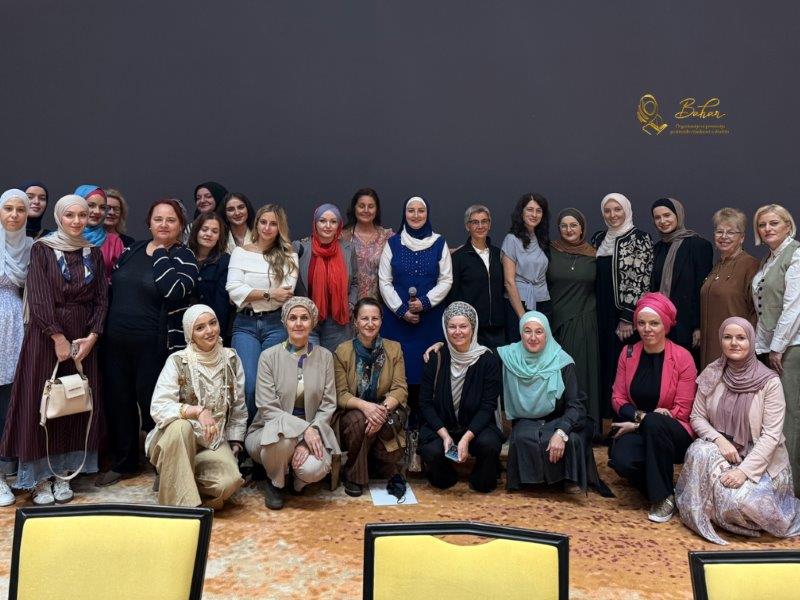
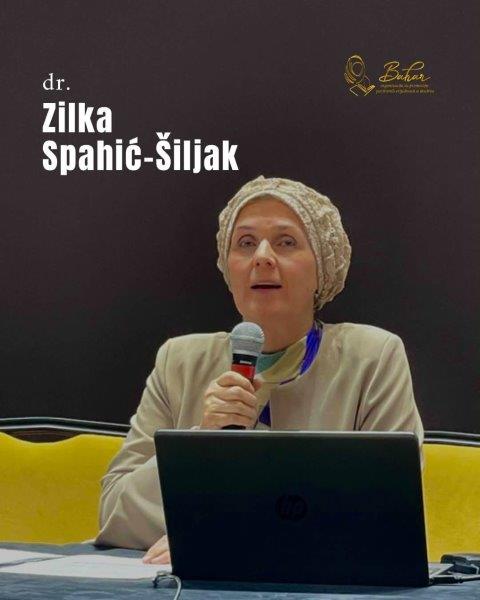
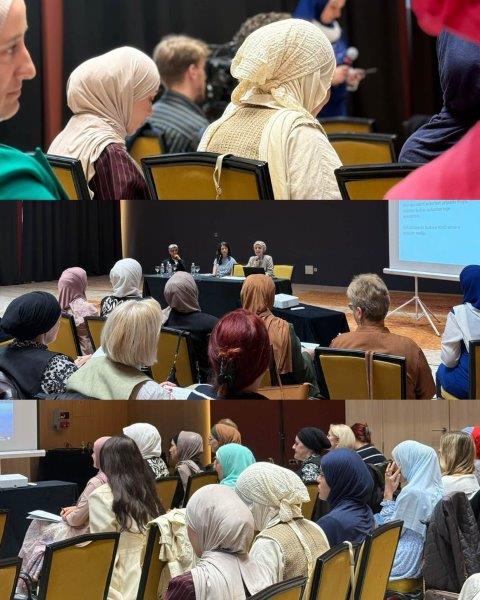
What happens when someone no longer presents a demand as their own opinion, but as God’s command? And where does legitimate religious authority end and its abuse begin? These questions were at the heart of Prof. Dr. Zilka Spahić Šiljak’s lecture on spiritual abuse, held as part of a seminar organized by Bahar.
Spiritual abuse was defined as the misuse of religious authority, sacred texts, religious norms, rituals, or relationships of trust in order to control, intimidate, shame, subordinate, or restrict another person’s moral and spiritual autonomy. One of the key messages of the lecture was that the problem is not religion itself. On the contrary, for people experiencing violence, faith can be a source of strength, meaning, hope, resistance, and healing. The problem begins when religious interpretation becomes a tool for legitimizing unequal relations of power.
Spiritual abuse therefore cannot be reduced simply to the question of incorrect interpretations of sacred texts. At its core is the question of power: who has the right to speak, who interprets, whose voice is considered authoritative, and what happens when a human interpretation is presented as unquestionable divine will.
The difference is simple, yet crucial. In an authoritarian relationship, someone may say: “I want you to obey me.” In a spiritually abusive relationship, the same message may be reformulated as: “God wants you to obey me.”
With this shift in language comes a shift in power. A human demand is no longer presented as a personal position, interest, family norm, or social expectation, but as a demand coming from God. In this way, resisting a person can be portrayed as disobedience to God, while questioning authority can be framed as a moral or religious transgression. This erasure of the boundary between divine authority and human interpretation is one of the central epistemological problems of spiritual abuse.
Islamic feminist hermeneutics insists on maintaining this distinction clearly: God is not the same as our understanding of God, sacred text is not the same as its interpretation, and religion is not the same as the social relations of power established in its name. Such an approach also requires a serious re-examination of authority. No individual, regardless of education, position, religious knowledge, or reputation within a community, has the right to present their own interpretation as the only possible one and equate it with God’s will.
Particularly troubling are situations in which concepts such as obedience, patience, sacrifice, shame, honor, or family duty are used to keep a person in a humiliating or abusive relationship. Religious language can then become a means through which violence is concealed, normalized, or even presented as a moral obligation.
For this reason, spiritual abuse is not only a theological issue. It is also a question of dignity, freedom of conscience, interpretive authority, and responsibility toward another human being.
One of the central messages of the lecture can be summarized as follows:
It is not enough to ask what a religious text says. We must also ask who is interpreting it, from what position of power, in whose interest, and what consequences that interpretation produces in the lives of others. It is precisely here that Islamic feminist hermeneutics offers an important corrective: it does not reject faith because of its misuse, but draws on the ethical foundations of Islam itself to challenge domination, monopolies over interpretation, and every attempt to sacralize human power. In this way, religion can once again become a space of liberation, responsibility, and dignity, rather than an instrument of control.
