
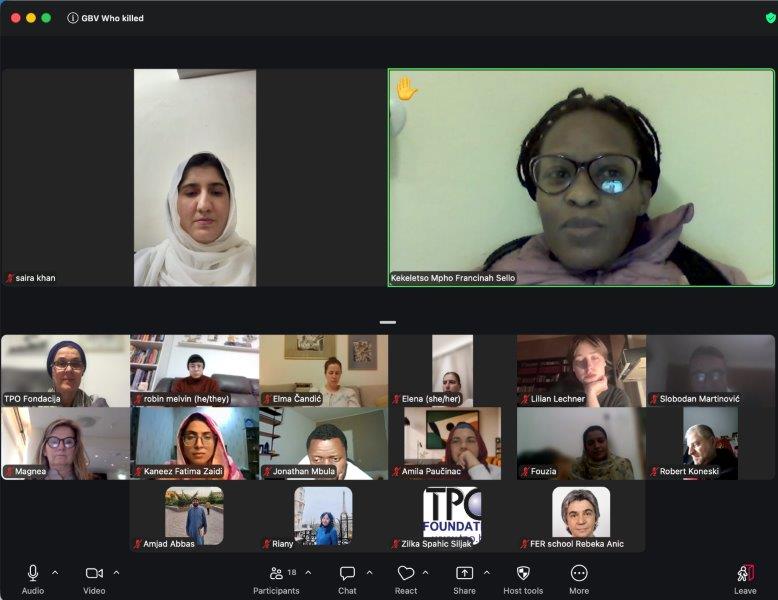
Gender-based violence is not merely an individual act of violence, but also a social phenomenon perpetuated through cultural norms, gender stereotypes, religious interpretations, and unequal power relations. These are precisely the issues explored in the course Who Killed God in Her? – Gender-Based Violence (GBV), offered as part of the 2026/27 winter semester at FER School (Feminism and Religion). The course brings together secular and religious perspectives to examine the causes, mechanisms, and consequences of gender-based violence. The introductory lecture was delivered by Dr. Jelena Ćeriman, who addressed the cultural normalization of violence.
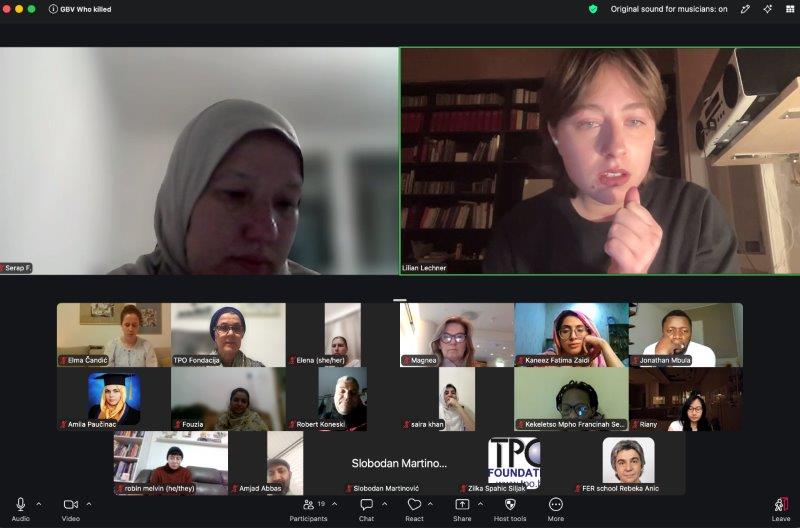
How does violence become so normalized that we no longer recognize it as violence? Who has the power to determine what constitutes acceptable behavior, whose voices are heard, and whose suffering is silenced? And what roles do culture, religion, and social institutions play in these processes? These questions are at the heart of the course Who Killed God in Her? – Gender-Based Violence (GBV), offered during the 2026/27 winter semester at FER School (Feminism and Religion).
The course approaches gender-based violence as a complex social, cultural, and religious phenomenon that cannot be understood solely through individual incidents of violence. Drawing on interdisciplinary and feminist theoretical approaches, it brings together secular and religious perspectives to critically examine the patterns through which violence is justified, normalized, concealed, or perpetuated within families, communities, and social institutions.
The introductory lecture was delivered by Dr. Jelena Ćeriman, who explored the cultural normalization of gender-based violence. The lecture focused on the interconnectedness of social norms, traditional gender roles, and everyday practices through which various forms of violence are presented as natural, private, or inevitable. Particular emphasis was placed on recognizing that violence is sustained not only through physical coercion but also through language, expectations, silence, social pressures, and beliefs that justify inequality between women and men.
In the following lecture, Prof. Dr. Zilka Spahić Šiljak examined different concepts of power, highlighting the importance of understanding power as one of the key elements underlying gender-based violence. Feminist theories demonstrate that power is not simply an individual’s ability to control another person; it is also embedded in social institutions, norms, knowledge, and discourses that determine what is considered legitimate, natural, and acceptable. Understanding the distinctions between power over, power to, power with, and power within makes it possible to examine not only mechanisms of domination but also the potential for resistance, empowerment, and social transformation.
The course will continue by addressing topics such as domestic violence, sexual violence during wartime, femicide, religious perspectives on violence, different forms of spiritual abuse, and psychotherapeutic approaches to supporting survivors of violence.
A particularly valuable aspect of the course is its integration of feminist critiques of social power relations with a critical examination of religious interpretations and practices. Religion can serve as a source of dignity, solidarity, justice, and protection against violence. However, certain religious interpretations can also be used to justify women’s subordination, control, and silencing. It is therefore essential to distinguish the fundamental ethical teachings of religious traditions from patriarchal interpretations that present inequality as natural or divinely ordained.
The course also provides space for reflection on different forms of violence, including physical, psychological, sexual, economic, symbolic, and spiritual violence, as well as the ways in which these forms intersect and reinforce one another. Particular attention is devoted to recognizing patterns that prevent victims and survivors of violence from speaking out, seeking support, and exercising their rights.
By combining theoretical knowledge, critical analysis, and dialogue, the course Who Killed God in Her? seeks to encourage participants to question deeply rooted assumptions about gender, authority, and violence, while developing their capacity to recognize and challenge various forms of discrimination and violence.
The educational mission of FER School is grounded in the belief that transforming violent social patterns begins with critically recognizing and questioning them. Challenging the cultural normalization of violence and unequal power relations is therefore not merely an academic endeavor, but also an important step toward building a society in which human dignity, equality, and freedom from violence are upheld as fundamental and non-negotiable values.
