
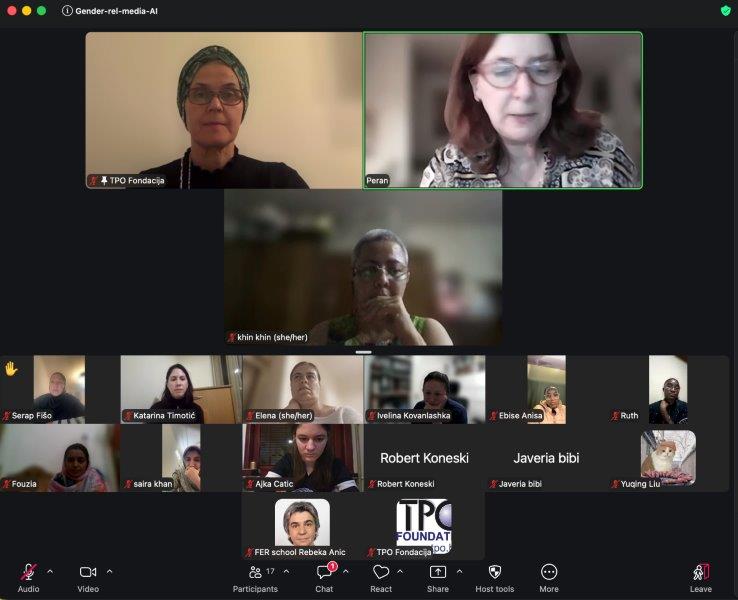
The media do not merely reflect social reality; they actively participate in shaping gender identities, religious representations, and power relations. In the digital age, algorithms and artificial intelligence raise further questions about who controls information, how stereotypes are created, and how social inequalities are reproduced. These are precisely the issues explored in the course Gender, Religion, Media and AI, offered as part of the 2026/27 winter semester at FER School (Feminism and Religion). The introductory lecture was delivered by Prof. Dr. Jasmina Husanović, who discussed the importance of the media, particularly new media, in mediating cultural content and shaping social reality.
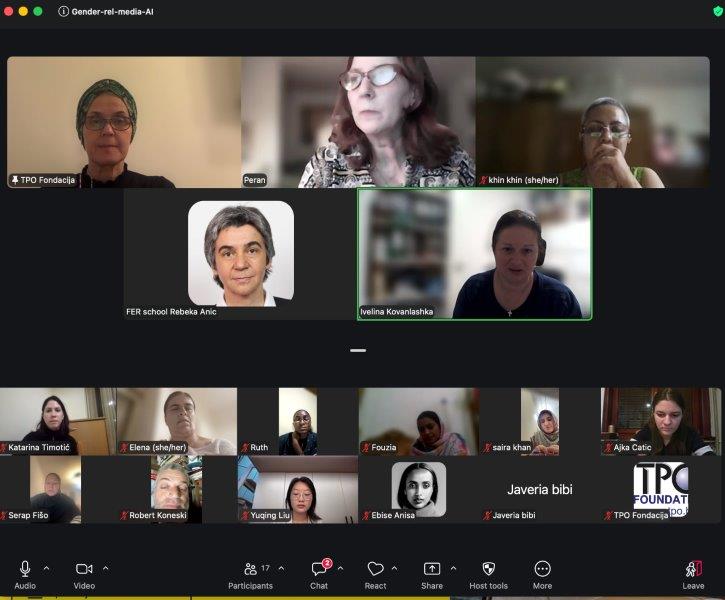
Who decides how women and men are represented in the media? Why are certain gender and religious representations continually reproduced? How do film, popular culture, and digital platforms shape our understanding of gender, religion, and social relations? And can algorithms and artificial intelligence be neutral when they are developed in societies marked by inequality?
These questions lie at the heart of the course Gender, Religion, Media and AI, offered during the 2026/27 winter semester at FER School (Feminism and Religion). The course provides an interdisciplinary approach to understanding how the media, cultural narratives, religious symbols, and digital technologies contribute to shaping gender identities and social power relations.
The introductory lecture was delivered by Prof. Dr. Jasmina Husanović, who opened a space for critical reflection on the interconnectedness of gender, religion, culture, and media representations. The lecture focused on how representations of women and men are constructed through different forms of cultural and media content, how social norms are established, and how popular culture can both reinforce and challenge dominant gender stereotypes.
In the following lecture, Prof. Dr. Suzana Peran continued the discussion on the relationship between gender, religion, and the media, placing particular emphasis on the importance of critically interpreting media content. The media are not neutral channels of information but spaces in which meanings are produced and communicated, social values are shaped, and boundaries are established between what is presented as normal, desirable, or unacceptable. Analyzing media representations of women, men, and religious identities therefore requires careful examination of language, visual messages, stereotypes, and power relations.
Throughout the course, participants will explore a range of topics connecting gender, religion, film, popular culture, advertising, and digital technologies. Particular attention will be devoted to how women are represented through contrasting images of saints and sinners, desirable and undesirable women, as well as how religious symbols and traditional gender patterns are employed in film and media narratives.
Another important topic will be gender representations in Yugoslav cinema, offering opportunities to critically examine social transformations, cultural expectations, and the ways in which female and male identities were constructed within different historical and ideological contexts.
A dedicated part of the course will focus on artificial intelligence and the algorithmic shaping of social reality. Digital platforms and artificial intelligence systems are not free from gender and other social biases. Algorithms are developed using data that often reflect existing inequalities, meaning they can reproduce stereotypes and discriminatory patterns. This raises important questions about the accountability of technology companies, algorithmic transparency, and the possibility of developing digital technologies that respect human dignity, equality, and diversity.
Feminist approaches to media and artificial intelligence allow technological issues to be understood not merely as technical matters but also as ethical, political, and social questions. Who has the power to produce knowledge? Whose experiences remain invisible? Who decides which information becomes accessible and which voices are marginalized? These questions are particularly important at a time when digital technologies increasingly shape public spaces, education, and everyday life.
Through lectures and discussions, the course Gender, Religion, Media and AI aims to empower participants to critically interpret media messages, recognize gender and religious stereotypes, and engage responsibly with emerging technologies.
The educational mission of FER School extends beyond the transmission of knowledge to developing the ability to recognize and question the patterns that shape our understanding of the world. In this sense, critical analysis of media and artificial intelligence becomes an essential part of feminist education and efforts to build more equitable, responsible, and inclusive social relations.
