
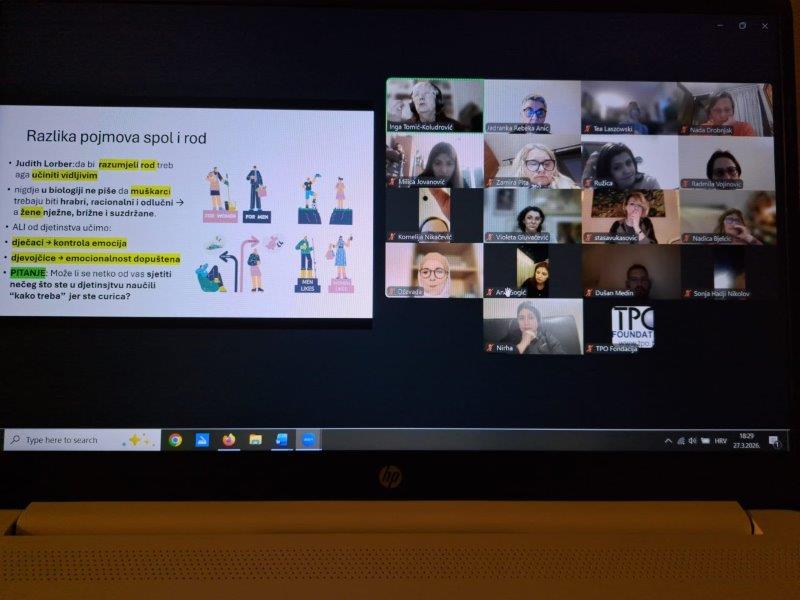
On March 27, 2026, a course titled “Forgive Me, My Wife”began as part of the FER school, with a lecture by Prof. Dr. Inga Tomić-Koludrović. A statement such as “Forgive Me, My Wife”may seem harmless at first glance, like a joke or an ordinary phrase people use out of habit, without special meaning. However, contemporary sociology of gender warns that such “small things” are never just words. Behind them often lie deep social structures that shape how we understand gender relations.
Unlike laws or formal institutions, which clearly regulate society, gender differences are often produced through everyday, almost unnoticed practices, language, humor, and habits. These “small things” function as micro-rituals of the symbolic order. Through them, certain ideas are constantly repeated until they begin to appear as “common sense.”
The phrase “Forgive Me, My Wife”implicitly carries several important assumptions: that a woman is a potential source of impurity or shame; that mentioning her requires an apology or qualification; and that female identity is something that needs to be “softened” in public speech. In other words, although it may sound like a joke, the phrase actually suggests that a woman is something problematic or of lesser value.
We can observe similar logic in other sayings and beliefs, such as: “A woman brings bad luck if she is the first to enter the house,” as well as various jokes that portray women as less rational or capable. All these statements contribute to the same image: woman as the “other”, something impure, dangerous, or inferior.
The problem is not in a single saying, but in their repetition. When we hear them daily, we begin to perceive them as natural and normal. In this way, gender hierarchy is not imposed openly, but is quietly embedded in our way of thinking.
It is precisely through such “small things” that we learn what is considered normal and who, within that order, has more or less value. Therefore, understanding language is not only a matter of communication, but also a matter of power.
