
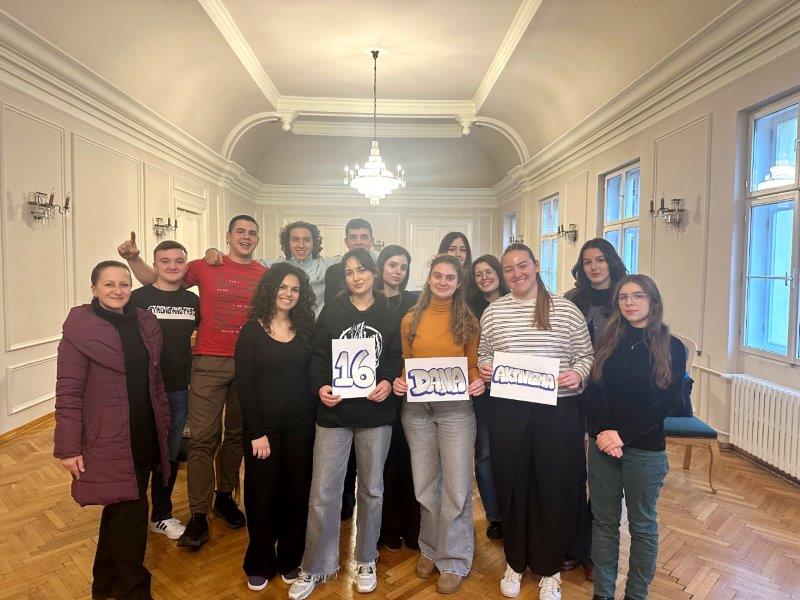
Within the global “16 Days of Activism Against Gender-Based Violence” campaign, students of the Third Gymnasium of Sarajevo, in cooperation with the TPO Foundation, actively participated in this important initiative through a series of educational and creative activities aimed at promoting nonviolence, dialogue, and social responsibility. The activities were led by professors Đuldina Kurtović and Esada Grabus, and school counselor Aida Rustanović.
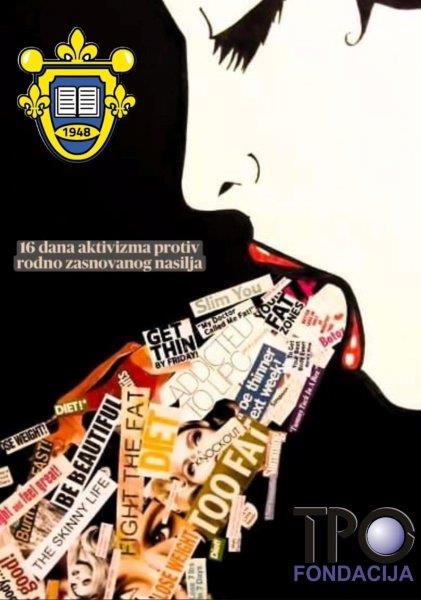
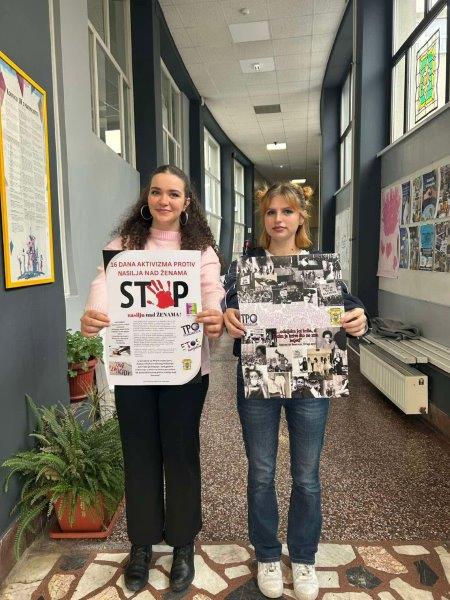
The campaign at the school began on November 25, 2025, with the opening of a poster exhibition in the school hallway. Members of the Critical Thinking Club took part in designing the posters, using visual messages to highlight the problem of gender-based violence, the importance of recognizing violence, and the need to respond.
The exhibition carried a strong symbolic and educational message—that violence is never a solution to problems, that dialogue is the foundation of every healthy relationship, and that it is important not to remain silent when violence occurs, but rather to offer support and seek help.
On December 1, 2025, a lecture was also held on the topic:
“Education on Gender-Based Violence, Media and Religion – How Violence Is Justified Through Religion and Mechanisms for Resisting Such Narratives.”
The lecture was delivered by Professor Esada Grabus for students of classes IV3 and III2. Through an interactive presentation, students analyzed the ways in which gender-based violence is concealed or justified through misinterpretations of religious teachings; normalized through sensationalist media reporting; or, on the other hand, critically exposed through responsible media.
Special emphasis was placed on the key mechanisms for combating harmful narratives, including:proper and responsible religious education, development of media literacy, strengthening critical thinking, and recognizing manipulative messages in the public sphere.
The goal of this educational session was to empower students to recognize violence, understand its causes, and actively contribute to building a safer, more just, and more equal society.
An important contribution to the campaign was also made by students of class IV-2, who, through a discussion on violence using the problem analysis method and the creation of a “Problem Tree,” identified current forms of violence, their causes, and their serious consequences for individuals and the community.
It was concluded that trust plays a key role when it comes to seeking help—both in relation to society and to the competent institutions.
