
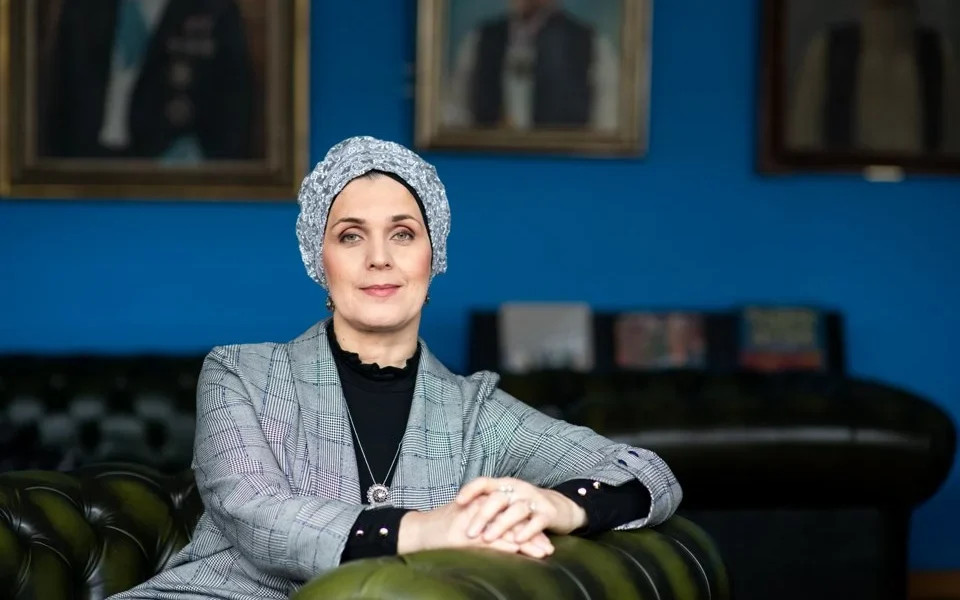
Prof. Dr. Zilka Spahić Šiljak
Originally published in Radio Sarajevo, November 7, 2026
Today, everything is advertised, marketed, and increasingly commercialized and religion is no exception. In fact, religion is particularly susceptible to exploitation, manipulation, and abuse precisely because it appeals to our deepest and most intimate emotions.
Imagine a promotional advertisement for Bosnia and Herzegovina with magnificent mountains, emerald-green rivers, hospitable people, and, of course, Bosnian coffee, ćevapi, and good music. But alongside these attractions comes a special offer aimed at men from abroad, primarily from Arab countries, though not exclusively: beautiful, white, blue-eyed Muslim women, wearing hijab, chaste, ready for marriage, and, most importantly, they do not demand a high mahr (bridal gift). You can supposedly “get yourself” a wife for €500.
It is as though we have returned to a medieval slave market. The difference is that we no longer see the familiar images of chains and slave owners bidding for human beings. Instead, we see modern-day traders who profit from the commodification of women. Young women wearing hijab and even underage girls have become a new tourist attraction!
Unfortunately, this is not the first time that women and girls in Bosnia and Herzegovina have been presented as commodities that can be obtained for very little money. These advertisements took me back to 1993, to the war, when we witnessed terrible abuses by individuals who, hiding behind humanitarian work and religion, exploited people’s poverty and desperation. At the time, I heard of cases in which girls aged fourteen to sixteen were married off to men from Arab countries in exchange for basic necessities for survival.
There is one encounter from that period that I will never forget. I was returning home when, at the entrance to my apartment building, I saw a man sitting on the ground, drunk, crying, and muttering something unintelligible. When he noticed me, he suddenly shouted: “You women in headscarves and your bearded men are to blame for everything!”
I stopped, completely stunned. I could not understand why he was attacking me or what I had done to him. I could have walked past, offended and angry at his words. But something about his despair made me stop. I approached him and asked what had happened. Then, through his tears, he told me something that made my blood run cold. He said that he had given his fourteen-year-old daughter to an Arab man in exchange for two cubic meters of firewood and a stove.
Two cubic meters of firewood and a stove. That was the price of his daughter’s childhood, according to his account. The man was crying, saying that he could not live with what he had done to his own child. He had gotten drunk, perhaps in a desperate attempt to silence, if only briefly, the conscience that was tearing him apart.
And then I appeared a Muslim woman wearing a headscarf and in me he recognized everyone he held responsible for his tragedy. At that moment, my headscarf became, in his eyes, a symbol of those who, invoking religion, could participate in exploiting his misfortune. I was not responsible for what had happened, but I understood why his anger was directed at me. He did not see me as an individual. He saw a symbol of something he associated with his own guilt, despair, and loss.
Even today, more than thirty years later, I can still hear his words and picture him crying at the entrance to that building. But what occupies my thoughts even more is his fourteen-year-old daughter. Where did she end up? What happened to her? Did she ever manage to escape that relationship? That is why today’s advertisements promoting beautiful, chaste Bosnian Muslim women who supposedly demand only a modest mahr disturb me so deeply. Not because I believe that every international marriage is problematic, but because they remind me how easily the language of faith, charity, and marriage can be abused when women and girls are economically and socially vulnerable.
More than three decades have passed. Today, we face new forms of economic pressure, new intermediaries, and digital platforms that promise women security and a better life while simultaneously presenting them as desirable marriage prospects.
And let us not deceive ourselves, women are marketed and objectified through the media in many different ways. Unfortunately, women’s bodies and sexuality have become commodities traded by powerful entertainment industries, while much of the public consumes such content without critically questioning it.
The Zefaaf platform, which presents itself as an international Muslim matchmaking service, promotes a special program for meeting prospective wives in Bosnia and Herzegovina. For a relatively small fee of just €500, it offers interested men organized meetings with women and their families, counseling, and certain forms of administrative assistance.
To be clear, this is the agency’s matchmaking fee. But when such an offer is combined with the advertising of Bosnian Muslim women as chaste, white, blue-eyed, and modest in their expectations, a far more serious question emerges What image of women is being promoted in the international marriage market?
Many agencies specialize in matchmaking. The issue is not necessarily matchmaking itself, but what is being advertised and how. Reputable agencies present both women and men as individuals with education, professional aspirations, expectations of their prospective partners, and, ultimately, the freedom to make decisions about their own lives. Yet all of this seems to matter less than eye color and a low mahr.
When Do Women’s Honor and Dignity Matter to Us?
Videos posted by the Zefaaf platform have provoked strong reactions on social media, particularly after a representative of the platform filmed promotional material outside the Divan café in Sarajevo, near the Gazi Husrev-beg Madrasa. The owners of Divan publicly distanced themselves from the content, stating that the filming had not been authorized, announcing that they would report the matter to the relevant authorities, and banning those responsible from entering the premises.
Warnings about the activities of marriage intermediaries also appeared on Facebook. In one statement reported by newspaper Oslobođenje, a group called “Bošnjaci” warned that, according to their information, prospective husbands were being offered introductions to women for first, second, third, or even fourth marriages.
The group also raised concerns about the alleged involvement of local intermediaries operating within religious circles. Have we noticed how quickly we react when someone from outside attempts to portray Bosnian Muslim women as affordable marriage prospects? Suddenly, everyone speaks of honor, dignity, the reputation of the nation, “our daughters,” and “our women.” But where is that same determination when women remain trapped in unregistered marriages, without secure rights to marital property or legal protection?
Where are those reactions when women warn about violence, economic control, or the abuse of religious authority? Why do we defend women’s national honor so loudly, while defending their individual freedom so quietly? And what exactly do we mean when we say “our women”? Are women the property of a nation, a family, or men who believe they have the right to speak on their behalf?
From my own religious and feminist perspective, I ask a simple but uncomfortable question: Do we defend women because they are autonomous human beings, or because we regard them as symbols of collective identity? If our only objection is that a foreign man is trying to commercialize “our girls,” then we have reduced the problem to the question of who has the right to control women. Yet the real question should be entirely different: Why should anyone have such a right in the first place?
A woman is not a national asset. She is not family property. She does not belong to a man. Nor is she a symbol that a community can use to demonstrate its own moral superiority. A woman is a free-thinking human being, endowed with the same rights and responsibilities as a man, both before God and before other human beings.
Less Mahr, More Fun
In Islamic law, mahr is a woman’s financial right, explicitly affirmed in the Qur’an (4:4). Mahr is not the price of a woman, nor is it compensation paid to her family for her body or virginity, although it has sometimes been interpreted and practiced that way in certain cultures. Mahr belongs to the woman, and she has the right to decide what to do with it. A woman may freely accept a modest mahr. That is her right, and there is nothing inherently objectionable about it.
However, when a matchmaking platform turns the amount of mahr into a selling point designed to attract clients, a woman’s right takes on an entirely different meaning. It becomes part of a commercial calculation. Consider the absurdity, a religious provision intended to offer women a degree of economic security is being used to promote their financial affordability. Particularly troubling is the portrayal of Bosnian Muslim women through ideals of white beauty, blue eyes, hijab, and sexual chastity. This brings together racial stereotypes, religious symbols, and patriarchal expectations. Such advertising tells us very little about actual Bosnian Muslim women. It tells us much more about the fantasy someone is trying to sell.
But why should a Muslim woman have to be white and blue-eyed to be considered especially desirable? Why is her religiosity measured through assumptions about sexual virginity? Since when has the hijab become a certificate of moral character?
In this way, religion becomes a commercial instrument. Religious language provides legitimacy, while the marketplace determines which characteristics are desirable. And, of course, those who profit are often people who care little about religion itself but readily exploit it for their worldly interests and the satisfaction of their desires.
When Marriage Lasts Only as Long as a Tourist Visit
There is another dimension that must be addressed carefully but openly: internationally documented abuses involving short-term and unregistered marriages. A 2019 report by UNDP, UN Women, UNFPA, and ESCWA examined various forms of marriage arrangements in some Muslim-majority countries, including misyar, mut’a, and certain unregistered ‘urfi marriages. These arrangements have distinct legal and theological histories and should not be treated as interchangeable.
Nevertheless, research indicates that, under certain circumstances, short-term marriage arrangements have been used to conceal sexual exploitation, particularly when wealthier men entered relationships with impoverished women or girls during tourist visits. A marriage that formally employs religious language can, in such circumstances, become a means of avoiding responsibility.
This is why verification and transparency are essential. Who guarantees that a man arriving in search of a wife is not already married? Who ensures that a woman knows his actual marital status, place of residence, and family circumstances? Can an intermediary claim religious legitimacy while failing to provide even the most basic conditions for protection under civil law? And ultimately, who is responsible if a man disappears after a brief visit and cuts off all contact? Where is the woman supposed to turn, apart from women’s shelters?
Prostitution Under the Cloak of Morality?
As early as 2015, Bosnia and Herzegovina’s State Investigation and Protection Agency (SIPA) conducted Operation “Lipstick” in Sarajevo, investigating suspected organized prostitution and money laundering. According to police statements, users of sexual services included foreign nationals of Turkish and Arab origin. Several suspects were arrested, while women were questioned as witnesses. Under the guise of Islamic marriage ceremonies, which were often conducted secretly and without legal consequences under Bosnia and Herzegovina’s civil law, prostitution was taking place. Thus, tourist and business trips were also being used for the sexual exploitation of women.
It is important that SIPA responded to numerous public appeals and media report that they are about to launch an investigation into the Zefaaf agency. But this is only one agency. What about the many other intermediaries who do not advertise their activities on social media but instead use other networks to recruit women and underage girls into temporary marriages involving financial arrangements?
Of course, not every unregistered marriage constitutes prostitution, just as not every paid matchmaking service amounts to human trafficking. However, the use of religious symbols and the legal institution of Islamic marriage cannot justify coercion, deception, manipulation, or exploitation. The greatest danger arises when religious terminology replaces genuine scrutiny of rights and responsibilities. We all bear responsibility for addressing this problem, and institutions bear a particularly significant share of that responsibility.
The Islamic Community in Bosnia and Herzegovina has long warned about the problem of informal polygamous marriages. In official responses, its representatives have emphasized that a marriage cannot be performed for a man who is already married, since doing so would violate the country’s applicable legal framework and would make it impossible to guarantee the rights of a second wife. These responses contain a particularly important message: polygamy is not an Islamic obligation, and questions of justice and the protection of women are of fundamental importance.
Nevertheless, alongside the official positions of the Islamic Community, which clearly condemn the abuse of religion and manipulation through Islamic marriages, there are online religious scholars who justify secretly conducted Islamic marriages and officiate such ceremonies.
This brings us to an essential question: If a marriage regarded as religiously permissible cannot be effectively protected before a court of law, is it enough to declare it formally valid? What is truly valid about such a marriage if the woman remains unprotected? Who assumes responsibility when a woman is left without property, financial support, or the ability to exercise her rights after a temporary marital relationship ends? And ultimately, can something be permissible within one normative framework while remaining deeply unjust in its actual social circumstances?
The answers to these questions go beyond the scope of this article. Nevertheless, it is important to emphasize that Islamic ethics cannot be reduced to a list of what is permitted and prohibited. Islamic ethics also encompasses justice, responsibility, and the prohibition of harm. For this reason, public discussions that devote greater attention to men’s supposed entitlement to additional marriages should instead focus on women’s dignity and their right to security. In all of this, we must be careful not to take away from women precisely what we are trying to protect their right to make their own decisions. Some Bosnian women wish to marry men from abroad. Some choose traditional relationships. Some accept polygamous marriages. Others do not wish to marry at all. It is not the responsibility of the state, the family, or feminist organizations to choose a partner on behalf of an adult woman. Their responsibility is to ensure that she can make her decision freely, with adequate information and without coercion, and that legal protection and support are available whenever she needs them.
The most dangerous situation arises when a woman believes she is fully protected by a religious marriage ceremony, only to discover that she has no effective means of enforcing her rights. For exploitation does not always begin with violence. More often, it begins with a promise. A promise of security, marriage, love, a better life and, above all, God’s pleasure. Sadly, it may end when a woman discovers that those promises were merely spoken words, that no legal documents exist, and that the person who made those promises is no longer available. A modest mahr is not, in itself, the problem. The problem begins when a woman receives the least protection precisely in the relationship in which she expects the greatest trust.
